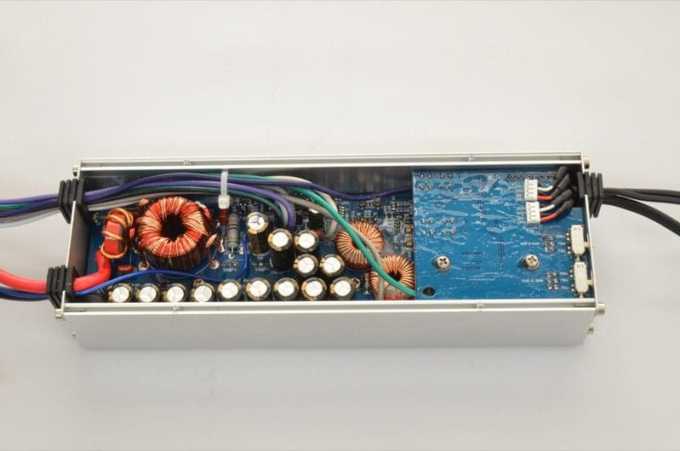
 It’s hard not to notice that almost every reputable car audio manufacturer now offers several ultra-compact amplifier solutions. These amplifiers are small enough to fit in the pocket of your jeans and help make installations easier when space is tight. While diminutive, they can deliver an impressive amount of power to upgrade the signal to your factory speakers or let aftermarket speakers transform your mobile sound system into an amazing listening experience. In this article, we’ll talk about how companies can cram so much power into such a small package and look at how these amps differ from conventionally sized solutions.
What is an Ultra-Compact Amplifier?
While small amplifiers from companies like Sony, Soundstream, Rockford Fosgate and Linear Power have been around for decades, most of these early solutions were limited to around 20 watts of power per channels.
 One of the first modern high-power compact amplifiers to make its mark in the industry was the Alpine Power Pack KTP-455U. Measuring roughly 8 by 2.5 by 1.5 inches in size, this four-channel amplifier could deliver a real-world 45 watts per channel into 4-ohm loads. Alpine marketed this amplifier as an easily integrated solution to upgrade a factory or aftermarket radio and deliver almost three times as much power to your speakers.
 A few years later, Rockford Fosgate introduced its Boosted Rail Technology series of amps. These amps use a unique and creative power supply design that was different from all the other solutions on the market. From a power-production perspective, the four-channel PBR300X4 could crank out 75 watts of power into a 4-ohm load and had a footprint of only 6.75 by 4.25 inches.
Fast forward five years, and there are dozens of companies with small, high-power amplifiers available. You can choose from four- or five-channel solutions to upgrade your sound system, and most offer a roughly 300-watt subwoofer amp to add big bass without taking up much space. Several models include water-resistant designs that make them ideal for marine, motorcycle and powersports applications.
Big Power in an Amazingly Small Package
Amplifier size is determined by two factors: how much space is required to house the components needed to make the amp work, and how much heat sink does the design need to dissipate heat reliably under all conditions.
One of the biggest technological advances that have allowed amplifiers to become so small is surface-mount devices. Thanks to subminiature resistors, capacitors, diodes, transistors and microcontrollers, circuits and their components can fit in half or a third of the space they used to require. Think about your smartphone — it has more processing power than desktop computers from 10 years ago, yet fits comfortably into the palm of your hand or a shirt pocket. By comparison, the computers that took the space shuttles into orbit ran at about 1.2 million instructions per second (MIPS) and had a total memory of a couple of megabytes. The Apple A11 processor found in the iPhone X can manage a jaw-dropping 600 billion instructions per second. With that said, the Apple CPU isn’t designed to handle the rigors of outer space and prolonged exposure to radiation — so keep that in mind if you’re planning a trip to Mars with our buddy Elon Musk.

The surface-mount Metal Oxide Semiconductor Field Effect Transistors (MOSFETs) used in the power supplies of these ultra-compact amplifiers have also allowed the amps to shrink in size dramatically. You can fit four of these devices on the end of your finger, and each one is capable of passing 50 amps of current. Thirty years ago, a single 50-amp transistor would have been bigger than all four of these modern devices.

Another technology that has reduced amplifier sizes is multilayered circuit boards. Four-layer boards provide significantly more options for connectivity among the devices in the circuit and reduce the space required for signal traces.
Finally, high-speed Class-D amplifier designs help to reduce current consumption in the output stage of the amp. Class-D audio amplifiers operate by switching the output devices on and off at extremely high speeds, and varying the duty cycle (on vs. off periods) recreates the original audio waveform. Because the devices are either on or off, they spend less time acting as a resistor and, subsequently, waste less energy as heat.
Are Compact Amplifiers the Perfect Solution?
With any benefit, there are often drawbacks. For ultra-compact amplifiers, three limitations need to be considered: cooling capacity, features and noise. As we mentioned earlier, fitting lots of parts into a small package is much easier, thanks to surface-mount devices and multilayered circuit boards. The drawback of a small amp is that it still needs a heat sink to the cool the switching devices. If we reduce the heat-sink area for a given power level, the amp will be more prone to overheating when pushed hard. You might be fine for one or two songs, but you likely won’t be able to jam on these at full-blast on a hot summer’s day in Arizona or Texas without them going into protection.
The features included with an amplifier are often based on the space available for controls and switches. If you want high- and low-level inputs, adjustable high-, low- and bandpass crossovers, infrasonic filters, signal summing, individual sensitivity controls, bass-boost circuits and remote level controls, you need lots of space. In an ultra-compact amplifier, that space simply doesn’t exist. As such, most of those features won’t be found on this class of amplifiers.
Finally, we need to talk about noise. Noise, or more specifically, signal-to-noise ratio (S/N Ratio) describes how much background noise (heard as hiss) is added to an audio signal when it passes through a device. The power supply and Class-D output stage of an amplifier produce a lot of high-frequency electrical noise. In a conventional and physically large amplifier design, these noisy circuits can be located physically and electrically far away from the sensitive input and signal gain stages of the amp. When we shrink an amplifier’s size by 30 percent, everything is much closer and thus more of this noise is added to the output signal.
Let’s look at five different four-channel Class-D amplifiers to compare noise levels relative each amplifier’s physical size.
Comparison of Four-channel Amplifier S/N Ratio
Amplifier Footprint Power / Channel S/N Ratio at 1 Watt
Square Inches Watts A-Weighted
Amp 1 26.76 50 >68 dB
Amp 2 41.99 70 >70.4 dB
Amp 3 60.41 75 >84 dB
Amp 4 68.07 75 >84 dB
Amp 5 89.03 150 >88.2 dB
As you can see, larger amplifiers add less noise to the output signal. While none of these specifications is atrocious, you will be able to hear a little hiss from the first two amps between songs and likely won’t on the top three amps. Of course, the third amp has a 50 percent larger footprint (length times width) than the second amp, so pick your poison appropriately.
Ultra-Compact Amplifiers Offer Unique Installation Solutions
If you are trying to add an amplifier to a motorcycle or a side-by-side and finding space for the amplifier is a concern, then, by all means, choose one of the many ultra-compact amps that are available. With that said, if you have a little extra space, larger amps offer better noise performance and more features. In this case, you get an audible improvement in performance by investing a little more money.
If you are interested in upgrading your mobile sound system, drop by local specialist mobile electronics retailer and speak to one of their product experts. They can provide you with several options to dramatically improve the sound quality and volume level of your existing system.
This article is written and produced by the team at www.BestCarAudio.com. Reproduction or use of any kind is prohibited without the express written permission of 1sixty8 media.
 If you look at some amateur car audio forums and Facebook groups, you’ll see a disturbing trend of people using speakers that are intended for home applications in their cars. While these speakers initially seem to offer impressive performance for their price, they simply aren’t designed to withstand the challenges associated with a mobile audio system. In this article, we’ll delve into what makes a “real” car audio speaker the only choice for your next
  We’ll get into the environmental challenges of
  Marketing departments often take advantage of the topic of speaker power handling to inflate the perceived quality or value of a speaker. Printing a “peak power” number that is four or five times the continuous power handling number is functionally useless.
 You can tell a lot about the knowledge and experience of a speaker designer by analyzing the specifications and features of an entire series of speakers. How one speaker is intended to work with the models that operate in adjacent frequency ranges is quite telling. For mid-range and mid-bass drivers, power handling is a significant consideration, but so is excursion capability. In terms of speaker specifications, the Xmax spec describes how far forward or backward a speaker can move linearly. If you double this value and multiply it by the effective cone area, you get the total volume of air a speaker can displace.
 Face it: Speakers designed for car audio applications are essentially outdoors and exposed to ultraviolet radiation. You can imagine the importance of using designs and materials that can withstand UV in a
 Next, choose speakers from reputable car audio brands that focus on engineering rather than marketing. If you don’t have time to do the research for yourself, ask your local mobile electronics specialist what makes the brand you are interested in better than its competitors. If they can’t provide an answer based on physical features and designs, it might be worth continuing your shopping. To be clear, “They sound great” or “Lots of competitors use them” aren’t valid answers. Oh, and don’t be fooled by “price marketing.” Just because one speaker is more expensive doesn’t mean it has more features and technologies that make it sound good, or that it has undergone proper design testing.
 Years ago, upgrading your car stereo meant buying a new radio that would play MP3 files or that included Bluetooth hands-free calling and audio streaming. As automobile manufacturers have increased their interest in providing advanced infotainment features, the aftermarket head unit industry has evolved away from conventional single- and double-DIN radios with segmented displays to multimedia receivers with color touchscreens. In this article, we’ll look at why upgrading your older car or truck with a touchscreen radio is a great way to add convenience and functionality to your commute.
 Of course, the biggest benefit of having a touchscreen radio is the amount of information that can be provided. If you are playing an MP3 or WAV file, the song title, artist and album name are easily visible on the screen of the radio. If you are stopped at a red light, searching through your collection of music is quick and easy. Of course, displaying contact information for incoming phone calls is another huge benefit.
 A huge benefit of most touchscreen radios is that you can add a backup camera that will allow you to see what’s behind your vehicle when parking. A backup camera makes maneuvering safer and much more efficient. Parallel parking is much simpler when you know just how close you can get to the vehicle behind you or the curb.
 If you are like us, you enjoy fine-tuning your audio system to meet your listening preferences. Many touchscreen radios include multi-band graphic equalizers that will let you dial in the frequency response of your sound system for the music you enjoy. Some also include signal delay settings, crossovers and seating position options that allow your installer to create a realistic listening experience that mimics being at home in your living room or at the mixing console in a recording studio.
 Even the most basic of touchscreen radios includes support for MP3 and WMA file playback from a USB memory stick. As you step up in features and cost, support for WAV, FLAC, AAC and DSD high-resolution audio files is added. Smartphone and iPod connectivity is another common feature with these radios. You can plug in your device and charge the battery while listening to your music collection as you drive. Many units will display album art right on the touchscreen.
 Thanks to the iDatalink Maestro interface, mid- to high-end receivers can connect to factory infotainment systems like Ford Sync or Chrysler’s Uconnect. If you have a factory-installed backup camera or USB port, these can often be used with a new receiver. Parking sensors and vehicle configuration options for climate controls are additional commonly supported functions.
 If you are looking for something a little fancier and truly beneficial, check out the options for adding Apple CarPlay and Android Auto to your car. These smartphone integration technologies make it safer and easier to make phone calls, listen to incoming text messages and dictate a response or choose the music you want to hear. You can even ask for turn-by-turn navigation directions to an address in your phone book or a business address searched on the Internet. The navigation directions consider real-time traffic flow information to create an efficient route.
 Nobody will deny that the Apple iPod is single-handedly responsible for a massive shift in the portability of music. Sure, the Walkman and Discman were important components in the history of portable media players, but those technologies supported existing music formats in the form of cassettes and compact discs. The
  In the ’80s and ’90s, going to the record store was a thing. Music enthusiasts knew when new albums would be released and would plan their schedules around making time to be at the store early on those mornings so they’d be the first to get a copy. Fast forward to the 2000s, and access to new music is as simple as a click of your computer mouse or a tap on your phone and a short wait while the album downloads to your desktop or your
  Apple’s MFi (Made for iPod/iPhone/iPad) program is a licensing program for companies that develop hardware or software that is designed to communicate digitally with these portable media devices. The original program, called Made for iPod, was launched in 2005 at the Macworld Expo and has evolved to include AirTunes wireless streaming, wireless game controllers and, most recently, devices intended for use with the HomeKit system that mimics Google Home and Alexa functionality.
 The goal of the MFi program is to ensure that consumers are provided with a predictable experience. Functions may not always work the way you want, but they will work the same on every product that has been through the MFi certification program. Though iPod and iPhone connectivity is a relatively simple process, the recent popularity of CarPlay is where the standards really tax the resources of those who are developing products. Apple tests screen geometry, icon colors and the position of volume function overlays. It has stringent hardware requirements that include strict USB connectivity testing and requirements for an onboard gyro.
 In researching this article, we talked to several companies that develop products under the MFi program. One of them mentioned that they had seen a list of blacklisted device keys in a preview of iOS 12.1 for the iPhone Xs. What does this mean? Any device that connects to an iPod, iPhone or iPad through the Lightning connector must include a small microcontroller that includes a software key. Think of this key like a digital serial number. These microcontrollers are found on all Lightning cables as well as headphone and video adapters.
 Recently, we’ve seen an influx of inexpensive Lightning cables and charging adapters available for sale at the checkout counter of local gas stations, variety stores and hardware stores. While the price and convenience of these cables are alluring, we want to caution our readers about using devices that aren’t specifically approved by Apple.
 Let’s face it, most of us aren’t really happy with the
  Even the most exotic of factory-installed sound systems cannot produce amazing bass. For most of us, the speakers in the doors don’t play much below about 50Hz. This means we are missing out on more than an octave of the most fun part of our music.
 Beyond not having enough bass in a factory audio system, the next most common complaint is that the system won’t play loudly enough. While the speakers in your car are limited in their capabilities, the most common issue is a lack of power from the radio or
  If you have read any number of our articles here at
  For too long, adding a signal processor has been considered the icing on the cake when it comes to premium audio system design. The reality is, as soon as your budget allows for it, adding a processor can dramatically improve the performance of even a modest installation.
 If you have ever upgraded a sound system by switching from an inexpensive amp to a great one, you may have noticed there is less background noise or hiss. When listening to music in our vehicles, we need to try and ignore wind and road noise and sound from the engine and exhaust system. Having your local car audio specialist retailer add a layer of
  No, we aren’t dissing your gangster rap or John Fogerty CDs. There has been a trend of late to focus on high-resolution audio files like FLAC and DSD. While the mechanical limits of these file formats dramatically exceed the listening limits of all humans, the improvement in recording and mastering equipment required to create these recordings is of excellent quality. In short, even within the standard 20Hz to the 20kHz range, high-res audio files sound better because they are created better.
 The easiest upgrade is a
  Lots of us like to install car audio equipment at home in our driveway. Do-it-yourself car audio has been popular since the 1970s and always will be. The problem is, it takes more than a solid understanding of electrical theory and physics to install and configure a modern audio system. Qualified installers use tools like real-time analyzers to set crossovers and adjust polarity. They use oscilloscopes to match the amplifier sensitivity settings to the source unit. Investing in this gear is often out of reach for most do-it-yourselfers and often overlooked. If every aspect of your audio system isn’t optimized, you are short-changing yourself on performance.
 How’s that for a confusing idea? What we are talking about is replacing your existing audio equipment with even better products. Let’s say you had a set of $250 components installed in the doors of your car a few years ago, and the system is tuned to optimize those speakers with a digital signal processor. If you upgrade those to a set of $1,600 components and have the system retuned, the difference will be night and day. Your music will be clearer and more detailed. You’ll be able to pick out subtleties that were otherwise lost. Think of upgrading to amazing speakers like cleaning your glasses: Everything will suddenly become crystal clear. The same applies to upgrading your subwoofers. There is a lot of information in the bottom few octaves of your music. A better sub will recreate your bass with dramatically improved realism.